

Every small business that decides to hire a professional web designer eventually faces a delivery-model choice: work with a freelancer, a boutique studio or a web design agency. Search for an answer and you’ll find many pages arguing for one model over another. This guide compares the structures so you can decide which kind of provider fits your project.
Each model has trade-offs. A freelancer is often the right call for a clear, simple project when you want to work directly with one person. A boutique studio may suit a project that benefits from a small team and close communication. An agency can fit work that needs several disciplines, parallel capacity or structured support. This guide compares cost drivers, scope, expertise, communication, accountability, ongoing support and risk. If you’re still earlier in the journey, our guide to how to choose a web designer covers the full process; this article focuses on choosing a delivery model. If you haven’t yet decided whether to hire anyone, start with DIY versus hiring a professional.
Key Takeaways
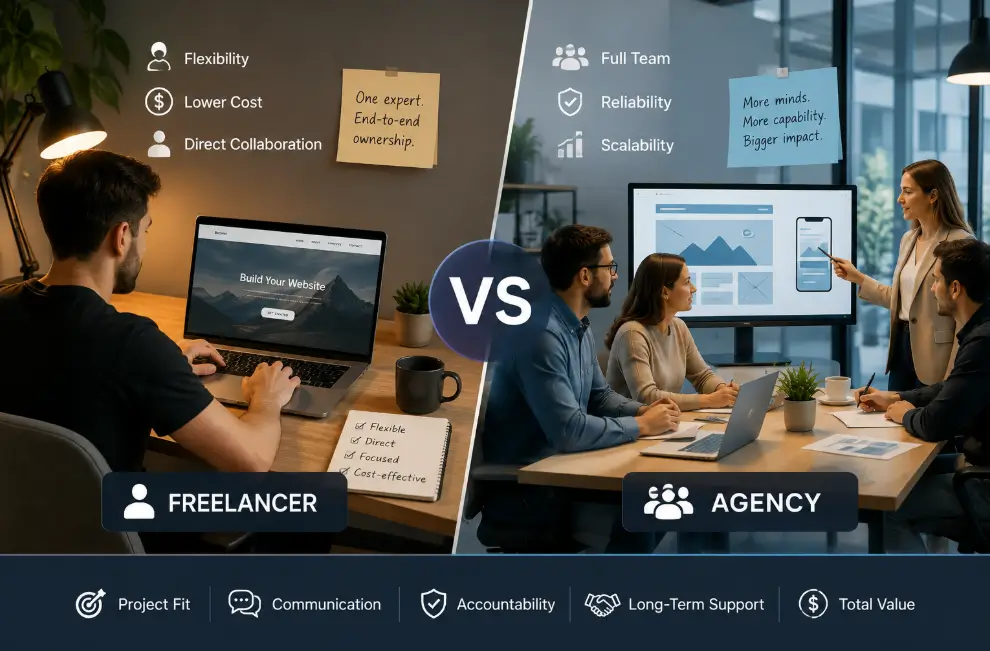
- The real difference isn’t price — it’s structure. A freelancer is one primary person, a boutique studio is a small team, and an agency is a larger structured team.
- A freelancer usually suits a clear, simple scope when you want to work directly with the person doing the work.
- A boutique studio may suit work that benefits from a small team, direct contact and a lighter process than a larger agency.
- An agency usually earns its fee when a project needs multiple disciplines at once, parallel work to a deadline, or structured ongoing support.
- Before signing, confirm who will do the work, what’s included, who controls your accounts, and how support continues after launch.
The Quick Answer
Choose a freelancer when your scope is clear and relatively simple, you want to work directly with one person, or you need a specific specialist. Consider a boutique studio when you want a small team with direct communication and more than one person available to contribute, but do not need a larger agency structure. Choose an agency when the project spans multiple disciplines, involves ecommerce or custom integrations, has several stakeholders, requires parallel work to meet a deadline, or needs structured ongoing support.
Provider type itself does not guarantee quality. A strong freelancer can outperform a weak agency, and a boutique studio can be the right fit when its team and process match your needs. The label narrows your options; the specific provider decides the outcome.
The Real Difference: Delivery Model, Not Price
Most comparisons frame this as “freelancers are cheap, agencies are expensive.” That framing misses the point. The real difference is structural, and price is a consequence of scope and structure together.
A freelancer is one primary person: you’re hiring an individual, and the project is shaped by that person’s skills, availability and working style. A boutique studio is a small team, often led by a founder or lead who stays close to the work. An agency is a larger structured team with specialists and project management. None is inherently better; each changes what a project can contain, how it gets done and what happens after launch. The sections below trace how those structural differences show up across the factors that decide your experience.
One Australian provider comparison, Spark Interact’s agency-versus-freelancer guide (published 26 August 2025), describes freelancers as direct, individual delivery and agencies as teams that can work in parallel. That is one provider’s comparison, not a universal rule. Boutique studios vary, so confirm the people, roles and backup arrangements in the proposal.
Freelancer, Boutique Studio or Agency: The Side-by-Side
The table below maps the three delivery models across the factors that matter most. Treat each row as a common pattern to check with a specific provider, not a fixed rule: boutique studios vary, and no row here is a published statistic. Compare the actual people, scope and support in each proposal rather than assuming every studio works the same way.
| Factor | Freelancer | Boutique studio | Agency | What it means for you |
|---|---|---|---|---|
| Cost | Ask for the total quote for the agreed scope; do not assume the provider label sets the price | Ask what’s included in the studio’s quote; prices depend on scope | Ask which team roles and coordination are included in the quote | Compare the same deliverables, GST treatment and support, not provider labels |
| Scope and complexity | Fits a clear, contained scope; specialists may bring in collaborators | A small team may cover design and development; confirm specialist coverage | Can coordinate several disciplines; check which roles are assigned | Matters most with ecommerce, integrations or custom builds |
| Expertise | One generalist, a deep specialist, or a lead with a trusted network | A small team with a mix of skills; capability depends on who will do the work | Several disciplines may be available; confirm seniority and assigned staff | Match the people doing the work to the skills your brief requires |
| Capacity and deadlines | One primary person’s time; work may need to happen sequentially | More than one person may contribute, but a small team still has capacity limits | May run work in parallel, subject to team availability | Ask who covers the work if the main contact is unavailable |
| Communication | Ask who your direct contact will be, and whether it is the person doing the work | Ask who your direct contact will be, and whether you can speak to the people building the site | Ask who your day-to-day contact is, and how specialist questions reach the people doing the work | Matters most if you value direct access over structured handoffs |
| Accountability | One person is responsible for the agreed deliverables | The studio is the delivery structure; confirm the contracting entity and named lead | The organisation manages delivery across its team | Put ownership, decision-making and handover in the agreement |
| Ongoing support | Ask whether after-launch help is available and how it is arranged | Ask whether the studio offers ongoing support and who provides it | Ask whether a retainer or support level is available and what it covers | Matters most if you need predictable help after launch |
| Risk profile | Single-person dependency | A small-team dependency; coverage depends on team capacity and documentation | Organisational overhead and handoffs | Ask how continuity and access are handled if a person or provider changes |
No model is automatically better. Each shifts where the advantages and risks sit, and which shift matters depends on your project.
Cost: What Actually Moves the Number
Cost is often the first thing people compare, but the headline figure alone does not show whether two providers are quoting for the same work. Before comparing totals, define the pages, content, integrations, delivery responsibilities and support you need.
What does move the number is scope. Almost every factor that adds work, risk or specialist time changes the quote:
- Number of pages — more pages, more design, more content, more testing.
- Custom design versus templates — bespoke work costs more than adapting a theme.
- Ecommerce and payment systems — product catalogues, checkout, payment gateways.
- Integrations — customer relationship management (CRM) software, booking systems, application programming interfaces (APIs) and client portals.
- Custom development — anything that isn’t off the shelf.
- Content, SEO and CRO — copywriting, search engine optimisation and conversion rate optimisation (CRO).
- Experience and team size — senior people and more hands cost more.
- Ongoing support — what happens after launch is a separate decision and a separate budget line.
A proposal from a freelancer, boutique studio or agency may include different staffing, project management, revision and support arrangements. Ask each provider to list the deliverables, named people, exclusions and after-launch support. This makes quote differences explainable without assuming provider type alone sets the price.
Rather than repeat detailed rate ranges here, we keep the current source-specific figures in our hiring guide for freelance web designers. It identifies the publisher, date, category and scope for each range, without turning them into a market average. The FAQ below links to that guide.
If you want to know how the difference shows up in the paperwork, our guide to web design contracts covers how ownership, exit and handover clauses vary between the models.
Scope & Complexity: What “Complex” Actually Means
”Complex projects need agencies” is the most common line in this debate — and it’s only half true. The useful question is what makes a project complex in the first place.
Complexity isn’t mostly about size. It’s about how many moving parts have to work together: an online store with payments and inventory, a booking system wired to a CRM, a bilingual site with custom functionality, integrations with third-party tools, or a design that must be handed to a developer and then to an SEO specialist without losing anything in translation. Each of those adds a coordination requirement — someone has to keep the pieces aligned.
Here’s the important nuance: complexity raises the coordination requirement, not automatically the quality of the work. A genuinely excellent freelancer with trusted collaborators — a writer they always use, a developer they subcontract, a specialist they call in — can absolutely deliver a complex project. What you’re really choosing is who carries the coordination load: the freelancer, the agency’s project manager, or (if you coordinate separate hires yourself) you.
For a breakdown of the build itself, our guide to what small business web design includes explains the components that drive both cost and complexity.
Expertise & Capacity: One Person vs a Team
It’s easy to assume an agency is automatically more skilled because it has more titles on the wall. That assumption deserves scrutiny. An agency can bring a designer, developer, SEO specialist, copywriter and strategist to a project — but it’s worth asking how senior each role actually is, and whether the people who pitched you are the people who will do the work. Meanwhile a freelancer is usually either a generalist, a deep specialist in one thing, or a specialist with a trusted network — and a specialist who does one thing extremely well can be the best possible hire for a project that needs exactly that thing.
The real structural advantage of a team is parallel capacity. When a project simultaneously needs design, development, content and SEO, a multi-person team can run those tracks in parallel instead of one after another. That matters most when a deadline is tight: a single person can only sequence so much work before the timeline breaks. For a project with a comfortable timeline, the sequencing constraint matters far less.
Communication: Who You Actually Talk To
Communication is where delivery models trade one strength for another, and neither direction is universally right.
With a freelancer, you often speak directly with the person doing the work. There’s no message relay, no summary that loses detail — what you say reaches the person who builds the site. That’s a genuine advantage for owners who want to be hands-on and hate repeating themselves. Its flip side: the same person handles every question, so availability can be a bottleneck.
With an agency, communication is usually more structured: a project or account manager is your day-to-day contact, and specialist work happens in the background with handoffs between roles. Structured can mean better-organised and clearer processes; it can also mean more layers between you and the person writing your code. The right choice depends on whether you’d rather talk to the worker or to a coordinator.
The pattern that matters most is how communication works before you pay — because that’s usually the best-case version. Our guide to web designer red flags covers how to read those signals.
Risk & Accountability: Two Different Failure Modes
Both models carry risk, but the risks are different — and naming them honestly beats repeating the usual stereotypes.
With a freelancer, the risk is single-person dependency. Your project lives or dies with one person’s availability. If they’re ill, on leave, or simply stretched, progress stalls. The mitigations are practical and should be settled up front: what happens if they’re unavailable, who holds the documentation and account access, whether backups and handover are arranged, and how continuity is handled if you part ways. These are the same ownership questions every provider should answer, and they’re worth confirming in writing.
With an agency, the risk is organisational overhead and handoff dependency. Because work passes between roles, things can get lost in transition — and the person who pitched you may not be the person who builds your site. The mitigations: confirm who actually does the work, who your day-to-day contact is, what happens if your account manager changes, how issues escalate, and what’s handled in-house versus outsourced.
Neither dependency makes the provider “bad” — both are structural, and both are manageable with the right questions. The deeper question of what to look out for when hiring anyone is covered in our guide to web designer red flags, which lists the warning signs that apply regardless of provider type.
Ongoing Support After Launch
Build cost and ongoing support are separate decisions — and the second one is too often an afterthought. A website isn’t finished at launch: it needs updates, security, backups, hosting, occasional fixes, and eventually new features or SEO work. Who handles that, and under what arrangement, should be decided before you commit.
Support arrangements vary by provider, so treat the patterns below as common tendencies to check rather than fixed rules. A freelancer may offer ad-hoc support or a simple care plan, which can be adequate for a site that changes rarely. An agency may offer a defined retainer with service levels, which matters when your site is business-critical and you need a predictable response. Ask each provider what its own arrangement is, and how quickly it responds to an urgent issue.
For the full picture of what ongoing care costs and what it buys, including how delivery models differ on maintenance, see our guide to website maintenance costs in Australia.
The Third Paths: Boutique Studios, Networks and Hybrids
The market isn’t limited to those two models. A small studio, a networked freelancer or a hybrid arrangement can provide another way to structure delivery. A boutique studio is a small team; a networked freelancer leads a project while bringing in trusted collaborators; a hybrid mixes models, such as one provider building the site and another maintaining it. The exact team and process vary, so ask who will do each part of the work and how support will be handled.
- Boutique studio. A small team may combine direct access to a founder or project lead with more than one person contributing to delivery. That can reduce reliance on a single individual’s availability, while offering a less layered relationship than a larger agency. Do not assume a studio has a fixed number of staff, a particular quality level or spare capacity. Ask who will design and build the site, who covers work if someone is away, and what support is included. DreamoonTech is one local example: the business publishes one-page and multi-page website packages through its small-business website development service. That is the company’s own offer, not a general boutique-studio price benchmark.
- Freelancer with a specialist network. A lead freelancer who coordinates trusted collaborators, such as a writer, developer or specialist, rather than doing everything alone. This can provide a single point of contact while bringing in additional skills. Ask who will contract with you and who owns each deliverable.
- Hybrid arrangements. For example, an agency builds the site and a freelancer maintains it afterwards, or a specialist contractor handles a specific piece of an internal team’s work. Hybrids can work well, but someone still needs to keep the parties aligned, and that responsibility should be agreed up front.
Use the decision criteria below to identify which delivery setup fits your project. The linked guide helps you assess a specific provider after you narrow the model.
The Decision Framework
Choose a freelancer when…
- Your scope is clear and the project is relatively simple.
- Budget is a genuine constraint and the value of direct collaboration is high.
- You want to work directly with the person doing the work.
- You need a specific specialist skill that one expert can deliver.
- Post-launch requirements are limited and ad-hoc support is enough.
Consider a boutique studio when…
- You want a small team with direct communication, but a single freelancer is not enough coverage for the work.
- Your site needs design and development, while the project does not require a large agency structure.
- You want the founder or project lead to stay close to delivery. Confirm who will actually do the work.
- You need a clear answer on capacity, backup and post-launch support before choosing.
Choose an agency when…
- The project spans multiple disciplines — design, development, content, SEO, CRO.
- Ecommerce or custom integrations are involved and need to work together.
- Multiple stakeholders need to be managed and kept aligned.
- A deadline requires parallel work that one person can’t deliver.
- Structured ongoing support with defined service levels matters.
- The website is business-critical and downtime has a real cost.
Either can work when…
Apply the same checks to every proposal: ask who will do the work, how the provider handles ownership and support, and whether the written scope fits your requirements. For a candidate-by-candidate assessment, use our guide to how to choose a web designer.
Questions to Ask Each Type
Beyond the standard questions every provider should answer, each model deserves a few type-specific ones.
Ask a freelancer:
- What happens if you’re unavailable for more than a few days — is there coverage?
- Do you use subcontractors, and who would actually do the work?
- Who owns and controls the domain, hosting and accounts?
- What support is available after launch, and what does it cost?
Ask a boutique studio:
- Who will design and build the site, and will I meet them?
- How many people can work on the project, and who covers it if someone is away?
- Which parts are handled in-house, and which are subcontracted?
- Who is my main contact, and who owns each deliverable?
Ask an agency:
- Who will actually work on my project — and will I meet them?
- Will I speak directly with specialists, or only with an account manager?
- Who is my day-to-day contact, and what happens if they change?
- What is handled in-house versus outsourced?
- How do issues escalate, and how quickly can I expect responses?
For the full checklist of questions to ask any web designer before signing — covering scope, pricing, ownership, revisions and support — see our complete guide to questions to ask a web designer.
Australia-Specific Considerations
In Australia, keep these four checks in mind:
Compare quotes GST-inclusive. A business registered for GST charges 10% GST on its taxable supplies. A quote that includes GST and one that excludes it are not directly comparable. The Australian Government’s GST guidance (accessed October 2026) explains the rate and when registration is required. Confirm each quote’s GST treatment before comparing providers. Our guide to comparing web design quotes gives the full method for lining proposals up fairly.
AUD pricing and location. Quote currency and pricing differ by location and provider type, and the same scope quoted by an interstate or overseas provider can come in at a very different figure. Our Adelaide web design cost guide covers local package pricing, and we keep the current published rate figures in our freelance web designer hiring guide.
Ownership is about your accounts, not the provider. Whether you hire a freelancer, a studio or an agency, your domain and hosting should be in your name. For example, auDA’s guidance on .com.au domain names (accessed October 2026) says a developer can register a domain on your behalf only with your explicit written permission, using your details and your company’s ABN, because the registration details determine who holds the licence. Our guide to web designer red flags covers the ownership warning signs in more detail, and they apply regardless of the model you choose.
Local versus remote is a separate axis. A local provider shares your time zone and a local reputation to uphold; a remote provider may offer a wider talent pool or lower rates. The local-versus-remote decision cuts across the delivery-model choice, and our guide to how to choose a web designer weighs it directly.
Frequently Asked Questions
Is a freelancer cheaper than a web design agency?
Not necessarily. The total depends on the agreed scope, who does the work, and what is included for revisions, handover and support. Compare like-for-like proposals instead of assuming the provider label determines value.
How much does a freelance web designer cost in Australia?
Published Australian rate guides give different figures depending on the publisher, date and scope, so there is no single verified market rate to quote here. We compare the current published guides with their dates, categories and limitations in our guide to hiring a freelance web designer in Australia.
What’s the risk of hiring a freelance web designer?
The main risk is single-person dependency — your project depends on one person’s availability and continued involvement. It’s manageable: confirm coverage for illness or leave, insist that domain and hosting are in your name, and get documentation and ownership in writing. These are structural risks, not reasons to avoid freelancers entirely.
Can a freelancer handle everything an agency can?
A strong freelancer can deliver a surprising amount — including complex projects, by coordinating trusted collaborators. The practical limit is parallel capacity: when a project needs several disciplines at once under a hard deadline, a single person can only sequence so much. Complexity raises the coordination requirement, not automatically the quality of the work.
Do freelance web designers offer ongoing support?
Support depends on the provider, so ask each one what it offers rather than relying on the label. A freelancer may offer ad-hoc help or a simple care plan, and an agency may offer a defined retainer. What matters is whether the arrangement covers updates, security, backups and fixes, and how quickly an urgent issue is handled.
When should I choose an agency over a freelancer?
Choose an agency when the project spans multiple disciplines, involves ecommerce or custom integrations, has multiple stakeholders, faces a deadline that requires parallel work, or when the website is business-critical and you want structured ongoing support. For a clear, simple scope on a tight budget, a freelancer is often the better fit.
Conclusion
This is not a contest with a winner. It is a choice between delivery models with different structures, and the right one depends on your scope, budget, communication preferences, support needs and tolerance for risk. A freelancer is often the smart choice for a clear, simple project; a boutique studio can fit when you want a small team and direct communication; an agency earns its fee when complexity, deadlines or ongoing support demand a larger team. In every case, judge the specific provider by experience, process, communication, ownership and evidence, not by the label. Our guide to how to choose a web designer shows you how.
If you’d like an honest read on which setup fits your project — including when the answer is a freelancer, a different provider type, or no professional at all — start a conversation. We’ll help you clarify your scope and requirements before you spend anything. And if you’d like to see how one provider structures its work and pricing, our service pricing is available any time.
Written by Ewen Zhang, Founder and Principal Engineer at DreamoonTech. Read more about the team on our about page. This guide was last updated on 15 October 2026 to add the boutique studio comparison and move detailed rate figures to the dedicated hiring guide.
Related reading
- Web designer vs web developer: which role your project actually needs.
- Web design process explained: what happens between kickoff and launch.
- Who owns your website: domain, hosting and account control.
- Small business web design: what a small business site typically needs to include.
- Questions to ask a web designer: the checklist to run before you sign with any provider.
